Home Catalogue of the Plants of Madagascar
The flora: higher plant groups
Orders
Families
Genera
Species
Any Name
Fern Index
Bryophytes
Red List
Specimen Full Search
Specimens with Vernacular names
References
Geographic Search
Collector Search
Search Builder
Project Query builder
(Login required)
New Publications
Photo Gallery
Specimens Scans
All Image Galleries
Liesner field guide
Liesner field guide pdf
APG links
Generic Tree Key
Web Sites
Glossary Fr/Eng
Adansonia
Bull. Soc. Bot
Flore de Madagascar
Botanicus
Gallica
Bioclimate
Geology
Protected Areas
Regions
Provinces
Kew Vegetation Atlas
List of PAs
Nat. Parks
MBG Gazetteer
Fallingrain.com
Ethnic groups
EDGE Species
Plant Themes
JSTOR Plants
The Plant List
Notes Pteridologiques
Candollea
SAPM
JSTOR
Elevation
Île Rouge Wiki
Maps
OpenStreetMap
Jardins Botaniques
M'car PA's
New taxa
Catalogue
Decrease font Increase font Restore font

Welcome to the Homepage of the Madagascar Catalogue

You are invited to contribute to the Vahinala Project! 

  • If you notice errors, or missing taxa please let us known! You can send comments or additional information the following address .... (to be added some )

The project aims to assimilate information on all native and naturalized plant species in Madagascar, evaluating the available taxonomic literature and specimen base for each taxon. The primary result of the project is the Catalogue of the Plants of Madagascar, an online database. The Missouri Botanical Garden leads the Project in collaboration with numerous institutional and individual partners. We completed a synonymized list of accepted species in 2008 and in 2012 we have completed the taxonomic evaluation of the majority of all genera and compiled distributional, ecological, and conservation status information for most well-circumscribed accepted species (View Project Milestones). In 2017 we added a preliminary checklist of bryophyte species, and changed the name of the website from the Catalogue of Vascular Plants of Madagascar to its current name.

Data in the Catalogue as of Jan. 2024 indicate that a total of 249 vascular plant families are represented, comprising a total of 1,698 genera and 11,580 native species of vascular plants (angiosperms, gymnosperms, and ferns) known from the island, 9,329 (82%) of which are endemic. In addition, ca. 950 unpublished new species, all endemic, were identified in 162 of the 587 genera that were evaluated in 2017 (some of which have now been published). Based on this and the rate of discovery of new species over the last three decades, the total flora is projected to comprise at least 14,900 species. When all species are taken into account, including those that remain to be described, nearly 90% of the native Malagasy flora will be endemic [Updated in 2024 from: Lowry, P. P., II, P. B. Phillipson, L. Andriamahefarivo, G. E. Schatz, F. Rajaonary and S. Andriambololonera. 2018. Flora. Pp. 243–255 in S. M. Goodman, M. J. Raherilalao and S. Wohlhauser (eds.), The terrestrial protected areas of Madagascar: Their history, description, and biota. Association Vahatra, Antananarivo].

Using the Madagascar Catalogue (MadCat) - The pale green horizontal Menu Bar provides access to basic search functions and standard TROPICOS links, while links on the pale green vertical Navigation Bar provides links to data browsing options, and to advance search options. A quick search for any plant name can most conveniently be made from the Taxon Name box on the Navigation Bar. The 'Search Builder' generates species lists based on multiple project attributes including a keyword search on a taxon name, thus generating a list restricted to a certain family or genus by specifying this name in the Keyword search box. Image Search accesses all images on TROPICOS, while the Project Query Builder is available only to logged-in users (Project Login access is normally only provided to project personnel and contributors).

On most pages in the upper right corner the words 'Choose Project' appear, providing links that enable the user to switch between a Madagascar Catalogue Project view and a standard TROPICOS view, or to the corresponding page in other TROPICOS Projects. Click on the Catalogue of the Plants of Madagascar  header at any time to return to the Project Homepage.


What was new in 2025?

A total of 53 new names and new name combinations across 23 genera, including:

  • 19 new name combinations for taxa prevously placed within other taxa: including 6 in Rubiaceae by P. De Block (mostly spp. of Nesotarenna.
  • Four new subspecies combinations in the species Aloe subacutissima:
    • subsp. amboahangyensis
    • subsp. esomonyensis
    • subsp. ruffingiana
    • subsp. subacutissima
  • Cucurbitaceae checklist for MadagascarPhytokeys 267: 123-222 (Andriamiharisoa et al., Dec. 05, 2025) - with details for all 26 genera and 77 spp., of which 55 spp. and 5 vars, are endemic to Madagascar, and 5 newly recognised spp. awaiting formal publication.

Other recent taxonomic novelties

Newly added or revised treatments for Madagascar (last updated - 25 March 2019).Candollea Notes. The fourth in a new series of taxonomic notes on the Malagasy flora edited by project personnel and collaborators will be published in the twice-yearly journal of Geneva Botanical Garden and Herbarium. The first appeared in December, 2010. To date 25 short articles have been published dealing with diverse plant groups including:

Arecaceae
Pandanaceae
Brackenridgea
Capuronia
Cissus
Croton
Cyperus
Didymoplexis
Diospyros

Garcinia
Hetaeria
Indigofera
Korthalsella
Memecylon
Mimulopsis
Mimusops
Nervilia
Ochna

Peltophorum
Psychotria
Rhodocolea
Stereospermum
Tabernaemontana
Tina
Vernoniopsis
Xerochlamys

 ...read more and access series index


The Protected Areas of Madagascar

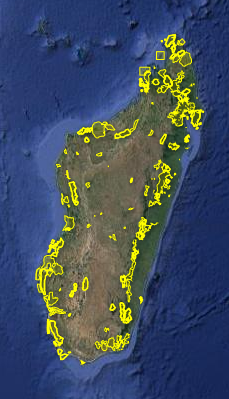
Following the dramatic increase in the Protected Area Network in Madagascar, and the publication in 15 April 2021 of "Les aires protégées terrestres de Madagascar : Leur histoire, description et biote / The terrestrial protected areas of Madagascar: Their history, description, and biota.", we have worked towards updating data in the Madagascar Catalogue for the entire protected areas network. We have placed special emphasis on the sites designated as KBA (Key Biodiversity Areas) by CEPT (The Critical Ecosystem Partnership Fund). We present an updated interaction map of the network, and an Index to the Protected Areas of Madagascar.


Image Galery

In May, 2012, when we first provided the first count of the number of images available in the MadCat, we recorded 15,360 images of Malagasy plants currently available through the Madagascar Catalogue. Now, in 2026 the number has more that quadripled to 71,543 images, including photos of living plants and herbarium specimens, with more being added regularly. MadCat is richly illustrated with photos and high resolution scans of specimens.

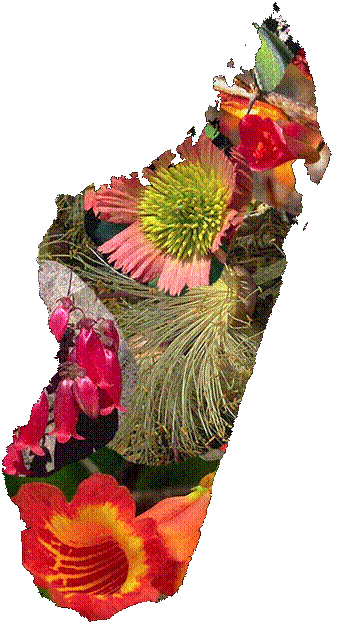
See a selection of some of our favorite Malagasy plants but clicking on the image below (and find out what it is!), or search using the Images link on the horizontal menu bar or use the  Image Galleries links on the sidebar for more image search options.

Links to images for all higher taxa are available on all Family and Order pages, see for example: Fabaceae or Lamiales.


Plant Themes

We are developing a series of MadCat special interest themes accessible through the 'Plant Themes' link on the Navigation Bar, or through the 'Search Builder'. These currently include:

The botanical diversity of inselbergs in Madagascar.

Marina N. Rabarimanarivo, Brigitte Ramandimbisoa, Nivo H. Rakotoarivelo, Peter B. Phillipson, Sylvie Andriambololonera, Martin W. Callmander & Stefan Porembski. 2019. Candollea 74: 65-83.

 • Parasitic Plants
 • Endemic Plant Families
 • Dye Plants


...more information and links


Red List of Threatened Malagasy Plant Species

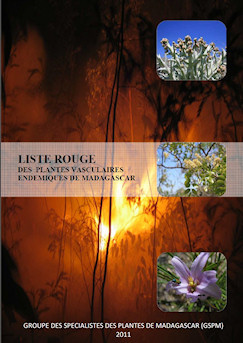
In conjunction with the Malagasy Plant Specialist Group of the IUCN, we have been undertaking Threat Analysis and Conservation Status evaluations of Malagasy Vascular plants. To date approximately 3,000 evaluation have been completed, and in May 2011 a first plant Red List for Madagascar was published. It includes 1,676 species assessed as Vulnerable, Endangered or Critically Endangered.


The Vahinala Project

Digital Library - The Vahinala Project is contributing to the development of online resources and is compiling a list of resources relevant to the plants of Madagascar. Online resources are growing rapidly, and important sites include:
BHL (Biodiversity Heritage Library)
Botanicus
Gallica
Google Books
JSTOR
Real JB Madrid

The Muséum National d'Histoire Naturelle in Paris has a valuable catalogue of online resources at:
Revues en ligne

Links to Other Key Resources

The Plant List
African Plant Database
JSTOR Plant Science (ex Aluka)
Flore Numérique d'Afrique Centrale
TROPICOS
SONNERAT
MBG Projects in Africa
Angiosperm Phylogeny Website


Kew Vegetation Atlas 

View online at: 

https://shop.kew.org/atlas-of-the-vegetation-of-madagascar


Partners & Sponsors

 • MNHN, Paris
 • CJB, Geneva
 • FO.FI.FA, Antananarivo
 • PBZT, Antananarivo


 • Andrew W. Mellon Foundation
 • Botanical Research Foundation of Idaho
 • JRS Biodiversity Foundation
 • Marisla Foundation
 • US National Science Foundation


...read more

We welcome feedback, please contact:
Peter PhillipsonSylvie Andriambololonera or Marina Rabarimanarivo.

The Project Team - The project team comprises MBG staff based in St Louis, Princeton, Paris and Geneva, and staff of MBG's Madagascar Research and Conservation Program based in Antananarivo.

...more information


Citing the Madagascar Catalogue:

Catalogue of the Plants of Madagascar. Missouri Botanical Garden, St. Louis, U.S.A. & Antananarivo, Madagascar [https://www.tropicos.org/Project/Madagascar] Accessed: ..... (indicate the date of accessing data on the site).

Last update: 11 July 2026

  • It includes taxonomic details, distribution data, and links to related resources. My analysis is based on the navigation structure, sample species entry, and the types of data and tools highlighted.

Main Themes:

  1. Taxonomic Organization:
    • The database is structured around the hierarchical classification of plants (orders, families, genera, species). For example, the entry for Aerva humbertii details its family (Amaranthaceae), genus (Aerva), and species.
    • There is a strong emphasis on synonymy and accepted names, reflecting the importance of accurate taxonomy in botanical research.
  2. Endemism and Distribution:
    • Many entries, such as Aerva humbertii, highlight whether a species is endemic to Madagascar. This underscores the island's unique biodiversity and the importance of documenting species with restricted ranges.
    • Distribution data is a recurring element, often specifying if a species is endemic or has a broader range.
  3. Conservation and Red List Status:
    • The presence of a 'Red List' section and references to conservation status indicate a focus on threatened species and biodiversity conservation.
    • Lists such as 'accepted redlist taxa' and 'all redlisted spp' suggest systematic tracking of conservation priorities.
  4. Specimen and Reference Management:
    • The database includes tools for searching specimens, references, and collectors, supporting research and verification.
    • There are options for managing specimen data, such as georeferencing and correcting invalid coordinates.
  5. Resource Integration and Tools:
    • The site links to a variety of resources: field guides, glossaries, vegetation maps, and external botanical databases.
    • Tools for data cleansing, name matching, and advanced queries support data quality and research efficiency.
  6. Project and List Management:
    • Users can create, append, or replace lists of taxa for various projects, reflecting collaborative and ongoing research efforts.
    • Numerous project lists (e.g., 'all native mad sp', 'MadCat Redlisted Jan 2015') indicate active curation and updating of plant data.

Patterns:

  • Hierarchical Navigation: The database is navigated by taxonomic rank, region, or project, making it easy to drill down from broad groups to specific species.
  • Emphasis on Endemism: Many entries and lists focus on endemic species, highlighting Madagascar's role as a biodiversity hotspot.
  • Integration of Conservation Data: Conservation status is integrated into species records and project lists, supporting conservation planning.
  • Comprehensive Data Management: The presence of tools for data validation, specimen management, and list creation shows a pattern of rigorous data stewardship.

Example Implementation:

  • A researcher interested in endemic herbs of Madagascar could use the database to filter by lifeform (herb), distribution (endemic), and conservation status (Red List), then export or manage a custom list for further study.

In summary, the main themes are taxonomic organization, endemism, conservation, specimen management, resource integration, and collaborative project management. The patterns reflect a systematic, research-oriented approach to cataloging and conserving Madagascar's unique plant diversity.

Summarise the conclusions that can be made from this page

Here is a summary of the main conclusions that can be drawn from the page, based on the structure and content of the Catalogue of the Plants of Madagascar:

Reasoning and Approach:

  • The page is part of a comprehensive botanical database focused on Madagascar's flora. It provides detailed taxonomic, distributional, and project-related information for plant species, using Aerva humbertii as an example. My summary is based on the navigation, data fields, and available tools and resources.

Conclusions:

  1. Comprehensive Taxonomic Documentation:
    • The database systematically catalogs Madagascar's plant species, including scientific names, synonyms, family placement, and publication details. For example, Aerva humbertii is listed with its synonym and publication source.
  2. Focus on Endemism:
    • The database highlights species that are endemic to Madagascar, such as Aerva humbertii, emphasizing the island's unique biodiversity and the importance of documenting species with restricted ranges.
  3. Integration with Conservation and Research Projects:
    • Numerous project lists and tools are available for managing species data, supporting conservation efforts, and facilitating research. Lists include categories like 'all native mad sp', 'accepted redlist taxa', and 'MadCat Redlisted Jan 2015'.
  4. Rich Resource and Toolset:
    • The site offers a wide range of resources, including field guides, glossaries, vegetation maps, and links to external botanical databases. Tools for data cleansing, name matching, and specimen management are integrated to ensure data quality and usability.
  5. User-Centric Data Management:
    • Users can create, append, or replace lists of taxa, reflecting a collaborative and dynamic approach to botanical data management. This supports ongoing research and conservation planning.
  6. Accessibility and Citation:
    • The database is accessible online, with clear citation guidelines and support for feedback, making it a valuable reference for botanists, conservationists, and researchers.

Example:

  • A botanist can use the database to identify endemic herbs in Madagascar, check their conservation status, and export a list for fieldwork or further study.

In summary, the page demonstrates a robust, research-oriented approach to cataloging Madagascar's plant diversity, with a strong emphasis on endemism, conservation, and collaborative data management.

  • It includes taxonomic details, distribution data, and links to related resources. My analysis is based on the navigation structure, sample species entry, and the types of data and tools highlighted.

Main Themes:

  1. Taxonomic Organization:
    • The database is structured around the hierarchical classification of plants (orders, families, genera, species). For example, the entry for Aerva humbertii details its family (Amaranthaceae), genus (Aerva), and species.
    • There is a strong emphasis on synonymy and accepted names, reflecting the importance of accurate taxonomy in botanical research.
  2. Endemism and Distribution:
    • Many entries, such as Aerva humbertii, highlight whether a species is endemic to Madagascar. This underscores the island's unique biodiversity and the importance of documenting species with restricted ranges.
    • Distribution data is a recurring element, often specifying if a species is endemic or has a broader range.
  3. Conservation and Red List Status:
    • The presence of a 'Red List' section and references to conservation status indicate a focus on threatened species and biodiversity conservation.
    • Lists such as 'accepted redlist taxa' and 'all redlisted spp' suggest systematic tracking of conservation priorities.
  4. Specimen and Reference Management:
    • The database includes tools for searching specimens, references, and collectors, supporting research and verification.
    • There are options for managing specimen data, such as georeferencing and correcting invalid coordinates.
  5. Resource Integration and Tools:
    • The site links to a variety of resources: field guides, glossaries, vegetation maps, and external botanical databases.
    • Tools for data cleansing, name matching, and advanced queries support data quality and research efficiency.
  6. Project and List Management:
    • Users can create, append, or replace lists of taxa for various projects, reflecting collaborative and ongoing research efforts.
    • Numerous project lists (e.g., 'all native mad sp', 'MadCat Redlisted Jan 2015') indicate active curation and updating of plant data.

Patterns:

  • Hierarchical Navigation: The database is navigated by taxonomic rank, region, or project, making it easy to drill down from broad groups to specific species.
  • Emphasis on Endemism: Many entries and lists focus on endemic species, highlighting Madagascar's role as a biodiversity hotspot.
  • Integration of Conservation Data: Conservation status is integrated into species records and project lists, supporting conservation planning.
  • Comprehensive Data Management: The presence of tools for data validation, specimen management, and list creation shows a pattern of rigorous data stewardship.

Example Implementation:

  • A researcher interested in endemic herbs of Madagascar could use the database to filter by lifeform (herb), distribution (endemic), and conservation status (Red List), then export or manage a custom list for further study.

In summary, the main themes are taxonomic organization, endemism, conservation, specimen management, resource integration, and collaborative project management. The patterns reflect a systematic, research-oriented approach to cataloging and conserving Madagascar's unique plant diversity.

Summarise the conclusions that can be made from this page

Here is a summary of the main conclusions that can be drawn from the page, based on the structure and content of the Catalogue of the Plants of Madagascar:

Reasoning and Approach:

  • The page is part of a comprehensive botanical database focused on Madagascar's flora. It provides detailed taxonomic, distributional, and project-related information for plant species, using Aerva humbertii as an example. My summary is based on the navigation, data fields, and available tools and resources.

Conclusions:

  1. Comprehensive Taxonomic Documentation:
    • The database systematically catalogs Madagascar's plant species, including scientific names, synonyms, family placement, and publication details. For example, Aerva humbertii is listed with its synonym and publication source.
  2. Focus on Endemism:
    • The database highlights species that are endemic to Madagascar, such as Aerva humbertii, emphasizing the island's unique biodiversity and the importance of documenting species with restricted ranges.
  3. Integration with Conservation and Research Projects:
    • Numerous project lists and tools are available for managing species data, supporting conservation efforts, and facilitating research. Lists include categories like 'all native mad sp', 'accepted redlist taxa', and 'MadCat Redlisted Jan 2015'.
  4. Rich Resource and Toolset:
    • The site offers a wide range of resources, including field guides, glossaries, vegetation maps, and links to external botanical databases. Tools for data cleansing, name matching, and specimen management are integrated to ensure data quality and usability.
  5. User-Centric Data Management:
    • Users can create, append, or replace lists of taxa, reflecting a collaborative and dynamic approach to botanical data management. This supports ongoing research and conservation planning.
  6. Accessibility and Citation:
    • The database is accessible online, with clear citation guidelines and support for feedback, making it a valuable reference for botanists, conservationists, and researchers.

Example:

  • A botanist can use the database to identify endemic herbs in Madagascar, check their conservation status, and export a list for fieldwork or further study.

In summary, the page demonstrates a robust, research-oriented approach to cataloging Madagascar's plant diversity, with a strong emphasis on endemism, conservation, and collaborative data management.

Tropicos notes:

The codes that qualify the status of a name in Tropicos are as follows:

Symbols Meaning
Accepted name
× Synonym
! Illegitimate name
? Uncertain name
***** Nomen nudum
° *Invalid name*
Rejected name
Conserved name
Basionym
Replaced synonym
Name with notes

 
© 2026 Missouri Botanical Garden - 4344 Shaw Boulevard - Saint Louis, Missouri 63110